
There are moments when the idea of simplifying your life sounds wonderful and completely unrealistic at the same time.
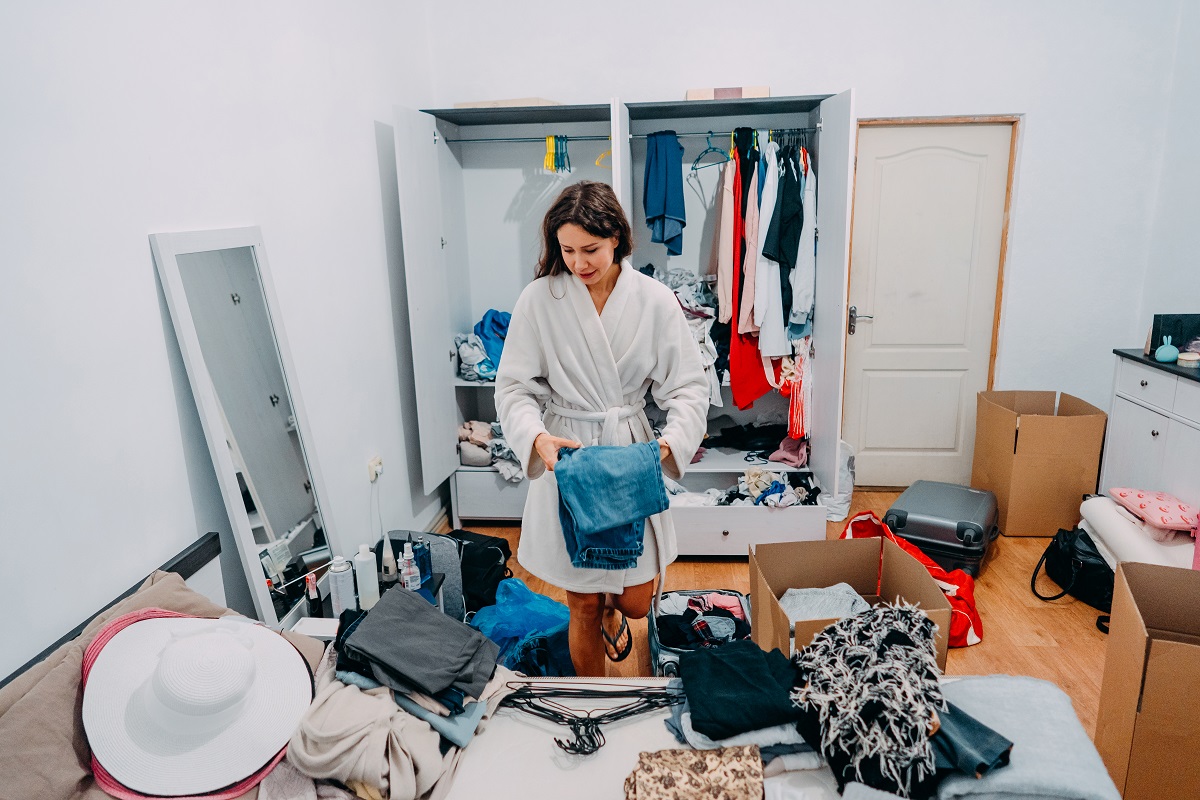
The laundry basket is full. There are unopened letters on the counter. A cupboard needs sorting, three bags have been sitting near the door for weeks, and something important is probably buried underneath the things you keep meaning to deal with.
Then you read about minimalism and discover that apparently you should review every possession you own.
That is the last thing an overwhelmed person needs.
When life already feels crowded, minimalism should make fewer demands on you, not become another improvement project requiring a free weekend, perfect decisions, and fifty empty storage boxes.
The better place to start is one pressure point, one reason you want things to feel easier, and one small experiment that gives you some immediate breathing room.
Table of Contents
ToggleStart With Relief, Not With Becoming a Minimalist
One of the least useful questions at the beginning is whether you are ready to “become a minimalist.”
It makes the change sound much larger than it needs to be. Suddenly you are not dealing with a crowded bathroom drawer. You are choosing a lifestyle, deciding what kind of person you want to be, and wondering whether the twenty-seven books on your shelf are compatible with your new identity.
Forget the label for now.
Start with what you want to become easier.
Overwhelm makes large projects feel even larger
When life is calm, spending a Saturday sorting a wardrobe may feel manageable.
When several other parts of life are already demanding attention, the same task can feel enormous.
There is the physical work of pulling things out and putting them back. There are decisions about what stays. There may be donations to arrange, items to sell, repairs to make, or things belonging to other people.
Even a productive decluttering session can temporarily make the room worse.
This matters because popular minimalist advice often assumes you have enough spare capacity to create disorder before creating order.
Sometimes you do not.
If you already feel overwhelmed, your first simplification should reduce pressure today. It should not borrow energy from the rest of the week.
You do not need a whole-house vision yet
There is nothing wrong with eventually thinking about how much you want to own or how you want your home to function.
But I would not start there when everything already feels like too much.
Start closer to the ground.
What makes mornings irritating?
What surface can no longer be used for its actual purpose?
Which cupboard do you avoid opening?
What do you repeatedly search for?
Where does stuff collect so quickly that tidying seems pointless?
Those questions lead to practical problems with practical answers.
The first goal is evidence that simpler can feel better
A small success matters because it changes minimalism from an abstract idea into an experienced benefit.
You clear enough of the kitchen counter to prepare breakfast without moving yesterday’s mail, a shopping bag, two water bottles, and a pile of miscellaneous objects.
The following morning feels slightly easier.
That is evidence.
You reduce an overcrowded bathroom drawer until the products you use every day can be reached immediately.
The next time you get ready, there is less rummaging.
That is evidence too.
You are not trying to prove how much you can remove. You are discovering which reductions make ordinary life easier.
Choose One Pressure Point Instead of Tackling the Whole House
Overwhelm has a way of turning individual problems into one giant problem.
The kitchen is messy, the closet is full, the garage needs attention, paperwork is accumulating, and there are several boxes you have not opened since the last move. In your head, all of it becomes “the house.”
Minimalism becomes manageable again when you shrink the target.
Pick the place that interrupts you most often
Do not necessarily start with the messiest room.
Start with the area creating the most repeated friction.
A crowded garage might look worse than a chaotic entrance table, but if you use the garage once a week and fight with the entrance table six times a day, the smaller space may deserve attention first.
Look for the places where you regularly:
- Search for something.
- Move objects before doing another task.
- Lose usable surface space.
- Buy duplicates because you cannot see what you own.
- Feel annoyed every time you open a drawer or cupboard.
- Leave things out because putting them away is too difficult.
Frequency matters.
Removing a minor annoyance that happens ten times a day may improve life more than transforming an impressive but rarely used storage area.
Make the starting area smaller than your first instinct
If you are thinking “wardrobe,” try one category of clothing.
If you are thinking “kitchen,” try one drawer or one section of the counter.
If you are thinking “office,” try the top of the desk.
If you are thinking “children’s toys,” choose one basket or shelf.
If you are thinking “paperwork,” begin with the visible pile rather than every document you have kept since 2014.
The point is to create a task you can complete.
An unfinished whole-room declutter can make an overwhelmed person feel further behind. One finished shelf gives you a usable shelf.
Avoid sentimental items at the beginning
I would not begin with family photographs, inherited possessions, children’s keepsakes, old letters, or objects connected to important periods of your life.
Those decisions can be worthwhile later. They are poor warm-up exercises.
Begin with possessions carrying very little emotional weight.
Expired toiletries.
Duplicate kitchen utensils.
Clothes you know you do not wear.
Empty packaging.
Broken items you have already decided not to repair.
Old promotional items.
Things that clearly belong somewhere else.
You are learning the process without making every decision difficult.
Choose a place where improvement will remain visible
A visible improvement provides a useful reminder that the effort accomplished something.
A drawer you use every morning is better for this than a box in the attic you may not see again for six months.
The kitchen counter, bedside table, bathroom cabinet, entrance area, dining table, or main wardrobe can all work well if one of them is causing daily friction.
You are looking for a small area with a high chance of paying you back quickly.
Do not let choosing the starting point become another project
There is a temptation to analyze the entire house before beginning.
You walk from room to room making lists. You create categories. Perhaps you download a checklist. Twenty minutes later, you have a much clearer understanding of how much work needs to be done and no actual improvement.
If several places seem equally reasonable, choose the one in front of you.
Starting imperfectly is fine because the first area does not commit you to a permanent order for everything else.
Know What You Want the Space to Do Before You Remove Anything
Decluttering is easier when there is a reason behind it.
Without one, every possession has to be evaluated in isolation. You pick something up and ask whether you like it, whether it is useful, whether you might need it one day, and whether getting rid of it is wasteful.
A purpose gives those decisions context.
Describe the problem in ordinary language
Instead of saying:
“I want a minimalist kitchen.”
Try:
“I want to be able to prepare dinner without clearing the counter first.”
Instead of:
“I need a simpler wardrobe.”
Try:
“I want to see the clothes I actually wear and get dressed without pushing through things that do not fit.”
Instead of:
“The living room needs decluttering.”
Try:
“I want the coffee table and sofa to be usable without moving things.”
The practical version makes it easier to know when you are done.
Use function as the first boundary
You do not need to decide what the perfect amount is for your entire life.
That question deserves its own consideration later.
For now, ask whether the space can comfortably perform its main job.
Can you cook?
Can you get dressed?
Can you sit down?
Can you find the medicine you use?
Can a child put the toys back without adult engineering?
Can the drawer close without pressure?
Function gives you a reasonable stopping point.
Decide what “better” would look like today
When you are overwhelmed, “finished” can sound impossible.
Use “better” instead.
Maybe better means half the dining table becomes usable again.
Maybe it means clearing enough floor space to walk comfortably through the room.
Maybe it means reducing one shelf until everything can be reached without removing the front row.
The smaller target is not lowering your standards.
It is matching the task to the capacity available today.
Use a Short Pressure-Point Reset When You Do Not Have Energy for a Big Cleanup
A short reset works because it limits both physical work and decision load.
You are not committing to minimalism for the afternoon. You are improving one small area for a fixed amount of time.
Fifteen minutes is a useful starting point, but ten may be better on a difficult day.
Begin by removing obvious trash and finished items
Start with decisions that require almost no thought.
Empty packets.
Expired products.
Receipts you do not need.
Broken objects you have no intention of repairing.
Packaging that has finished its job.
Disposable items that should already have left.
This is not the glamorous part of minimalism, but it creates room quickly.
More importantly, it does not ask you to decide whether an emotionally complicated possession belongs in your future.
Return things that obviously belong somewhere else
A cluttered space often contains objects that are not clutter in themselves. They are simply in the wrong place.
A jacket on the dining chair.
A screwdriver on the kitchen counter.
A child’s book in the entrance.
A clean towel in the bedroom.
Put obvious wanderers back where they belong.
If you discover that an object does not have a home anywhere, do not solve the entire storage problem immediately. Set it aside within the current area and keep moving.
Remove the easiest low-value possessions
Now look for things you can decide about quickly.
Duplicates you clearly do not need.
Items you actively dislike.
Products you tried and will not use again.
Clothing that is damaged beyond the amount of repair you are realistically willing to do.
Objects you have repeatedly passed over for years.
Do not force difficult decisions because the timer is running.
The point is to reduce obvious excess first.
Keep a very small “not today” category
Some objects will stop you.
You pick one up and immediately begin negotiating with yourself.
It was expensive.
Someone gave it to you.
You might need it.
You used to love it.
You are not sure whether someone else in the household wants it.
Put it into a small “not today” area and continue.
This is not permission to create twelve boxes of deferred decisions. The category exists to protect momentum during a short reset.
If uncertainty is taking longer than the item deserves, postpone it deliberately.
Restore enough empty space for the area to function
Once the obvious excess is gone, return what belongs.
Do not try to fit every square inch.
Leave enough room to take things out and put them back comfortably.
A bathroom drawer is easier to maintain when there is space around the products.
A wardrobe rail works better when hangers can move.
A pantry is easier to understand when food is visible instead of stacked three layers deep.
Empty space is not wasted storage. It is part of what makes storage usable.
Stop when the promised function has returned
This is where a small reset differs from an uncontrolled purge.
If your goal was to make the kitchen counter usable and it is now usable, you can stop.
You do not have to continue into the pantry because you are “on a roll.”
Momentum is useful, but so is finishing while you still have energy.
Ending successfully makes it easier to start another small area later.
Finish the exit step before declaring victory
The objects leaving the area need somewhere to go.
Trash reaches the bin.
Recycling reaches the recycling.
Donation items go to one designated donation place.
Things belonging to another room are returned.
Items belonging to another person are placed somewhere that makes the next action clear.
A pile on the floor labeled “deal with later” is not much of a simplification.
You do not have to drive donations away immediately, but create one departure point and one realistic trigger for taking them out.
Treat Minimalism as a Series of Small Experiments
Overwhelm becomes worse when every decision feels permanent.
Minimalism does not require that.
Many changes can be tested before you decide whether they belong in your life.
Try living without something before getting rid of it
If you are uncertain about a possession, remove it from normal use without disposing of it immediately.
Put it in a clearly labeled review box.
Choose a date to reconsider it.
Then notice what happens.
Do you go looking for it?
Do you need it?
Does the space work better without it?
Do you forget it exists?
The experiment produces evidence that imagination alone cannot.
Test one simpler routine before redesigning the room
Sometimes the problem is not the amount you own. It is what happens repeatedly.
The entrance may feel chaotic because five categories of things arrive there with no clear destination.
Before buying furniture or decluttering half the house, test a small arrangement.
Keys go in one bowl.
Mail goes into one tray.
Shoes stay within one defined area.
Reusable shopping bags return to the same hook.
Try it for a week.
If the space becomes easier to use, keep the rule. If everyone ignores the system, change it.
Experiment with less before creating strict numbers
You may suspect you have too many mugs, towels, toys, pantry items, or clothes.
You do not need to calculate the perfect number before reducing anything.
Remove the obvious extras first.
Live with what remains.
Does laundry become harder?
Do you run out of something regularly?
Is the cupboard finally easier to use?
Minimalism becomes more realistic when “enough” is discovered partly through daily life rather than decided entirely in advance.
Keep the changes that reduce maintenance
A successful experiment should lower the amount of work somewhere.
You spend less time searching.
Putting things away becomes easier.
You clean around fewer objects.
You stop buying duplicates.
A surface stays usable longer.
If a minimalist experiment creates more maintenance, reconsider it.
A simpler-looking system that requires constant attention is not necessarily making life simpler.
Slow What Comes Into the Home Before You Try to Fix Everything Already There
You can declutter for an hour every week and still feel stuck if new things keep entering faster than old things leave.
When energy is limited, slowing the incoming flow can be surprisingly powerful. It does not require sorting anything you already own.
Pause nonessential shopping while you find your footing
You do not need a permanent buying ban.
Try a temporary pause on categories that are already creating pressure.
If the wardrobe is crowded, pause casual clothing purchases for a few weeks.
If the kitchen cabinets are full, pause gadgets, mugs, serving pieces, and specialty equipment.
If children’s toys are overflowing, hold off adding more outside genuine needs and planned occasions.
A pause gives the current quantity time to become visible.
Ask where something will live before bringing it home
Before buying a nonessential item, imagine putting it away.
Is there an obvious place?
Will something else have to move?
Is the storage category already full?
If you cannot picture where the object will live, that is useful information.
The purchase may still be worthwhile. At least the storage cost is now part of the decision.
Do not let sales create emergencies
A discount creates artificial urgency.
The item is available now. The price may rise. Stock could disappear.
But a bargain on something you did not need still becomes another object you have to store and manage.
If sales are a common source of excess, create a simple rule: discounted items still have to pass the same usefulness and space test as full-price items.
The percentage off does not create more room in the cupboard.
Decline free things you do not want
Free objects can be difficult to refuse because saying yes appears to cost nothing.
Promotional items, hand-me-downs, samples, giveaway bags, spare furniture, containers, children’s items, and things relatives are clearing from their own homes all require space after they become yours.
Take what you genuinely want or need.
You do not have to accept an object merely because someone else needs somewhere for it to go.
Use a wish list as a waiting room
When you want something but are unsure, put it on a list instead of buying it immediately.
The list holds the decision without putting the object in your home.
Return to it later.
Some items will still make sense.
Others will look strangely unimportant once the original impulse has passed.
This is particularly helpful when life already feels busy because it postpones a low-priority decision without losing the option entirely.
Build Minimalism Around Your Available Energy
A simplicity system should still work during the weeks when you most need simplicity.
If it only works when you have spare weekends and unusual enthusiasm, it is probably too demanding.
Create three versions of the habit
Think in terms of full, normal, and minimum.
A full version might be sorting one cupboard for an hour.
A normal version might be a fifteen-minute reset.
A minimum version might be putting five things back where they belong and removing one obvious item you no longer need.
The minimum version sounds almost trivial.
That is why it survives difficult days.
You can maintain some contact with the simpler system without pretending every day has the same capacity.
Attach maintenance to the places that actually need it
You do not need a whole-house minimalist routine every week.
Some areas barely change.
Others collect new material constantly.
Pay attention to the entrances:
- The kitchen counter.
- The dining table.
- The hallway.
- The mail area.
- The wardrobe chair.
- The children’s main play area.
Reset the places where life creates new clutter.
Leave stable areas alone.
Do not turn missed maintenance into debt
This rule matters when life is already overwhelming.
If you miss the ten-minute reset on Monday, you do not owe twenty minutes on Tuesday.
If you do nothing for a week, you do not owe yourself a three-hour cleanup on Sunday.
Return to the normal amount.
The habit is there to support the home, not create another backlog.
Make Shared Spaces Simpler Without Starting a Household Battle
Minimalism gets more complicated when the things creating pressure do not all belong to you.
Your partner may like keeping more. Children may be attached to objects that look like obvious clutter to an adult. A housemate may have a completely different standard for shared spaces.
Trying to make everyone adopt your version of minimalism is likely to create a new kind of overwhelm.
Start with your possessions
Your own belongings are the safest place to make quick decisions.
You can simplify your clothes, books, personal paperwork, hobby materials, bathroom products, or other possessions without needing agreement from the entire household.
This also lets other people experience the benefits without being recruited into the project.
A calmer drawer is more persuasive than a lecture about why everyone owns too much.
Talk about the problem with shared possessions
When a shared area needs attention, describe the friction.
“We cannot fit groceries into this pantry” is specific.
“This house has too much stuff” is much broader and easier to hear as criticism.
“We need enough room on the dining table to eat” identifies a shared outcome.
Once the practical problem is agreed on, the household can decide what needs to change.
Create boundaries for spaces instead of controlling individual ownership
A defined shared space can create a reasonable limit without requiring everyone to want the same lifestyle.
Toys need to fit comfortably within the toy storage.
Shoes stay within the entrance area provided.
The dining table is cleared enough for meals.
Shared kitchen equipment fits within the available cabinets.
Private possessions can follow different standards in private spaces.
This allows the home to function without turning minimalism into a personality test.
Expect family systems to be less tidy than individual systems
A system used by several people needs to be forgiving.
Open baskets may work better than perfectly arranged shelves.
Broad toy categories may work better than ten labeled containers.
Hooks may work better than requiring coats to be hung carefully in a closet.
Ease of use matters more than visual perfection.
The system is successful when people can reasonably follow it on an ordinary Tuesday.
When You Feel Stuck, Make the Decision Smaller
Minimalism often stalls because one difficult decision starts representing all the others.
You pick up an expensive item you never use and suddenly you are thinking about wasted money, guilt, future possibilities, sustainability, and whether you make terrible purchasing decisions.
That is too much weight for one blender.
Separate the past cost from the current decision
Money already spent can make an unused item difficult to release.
Keeping it does not return the money.
But you also do not have to rush the decision simply to prove that you understand this.
Ask a smaller question:
“Do I want to keep giving this item space?”
If the answer is uncertain, use the review-box experiment.
You do not need to solve your feelings about every regretted purchase while clearing one cupboard.
Separate possibility from probability
Almost anything might be useful someday.
The more helpful questions are:
- How likely am I to use this?
- When did I last use it?
- How difficult would it be to replace or borrow?
- How much space does keeping it require?
A tiny specialized tool with a high replacement cost may be worth keeping for years.
A bulky inexpensive item kept for a remote possibility may not be.
“Just in case” deserves context.
Allow undecided to exist without letting it take over
You are allowed to be unsure.
What does not work well is allowing uncertainty to spread across the whole room.
Use one limited review container.
When it is full, review it before adding another.
This gives difficult decisions somewhere to wait without turning the entire house into a waiting area.
Use Progress to Reduce Overwhelm, Not to Create a New Standard
Once the first few areas become easier, there is a temptation to accelerate.
You start seeing clutter everywhere. Every cupboard becomes a possible project. Every purchase begins to look suspicious.
This is where minimalism can quietly become another source of pressure.
Do not keep going simply because you could remove more
A functioning space has earned the right to be left alone.
If the wardrobe closes comfortably, you can find what you wear, and putting clothes away is easy, it may not need another reduction.
If the kitchen works, you do not have to remove another pan.
If a collection gives you pleasure and has an appropriate home, it does not have to defend itself.
The aim is manageable life, not maximum removal.
Notice what has become easier
Minimalist progress often appears in small moments.
You find the keys immediately.
Putting clean laundry away takes less time.
The kitchen counter is ready when you need it.
You stop rebuying items because you can see what you own.
The donation bag actually leaves because there is one clear place for outgoing things.
You spend less time rearranging a full cupboard.
These improvements can look unimpressive compared with dramatic before-and-after photographs.
They are much closer to the reason simplicity matters.
Choose the next pressure point only when you have room for it
You do not have to move directly from one simplification project to another.
Let the first change work.
Enjoy the easier counter.
Use the calmer wardrobe.
Notice whether the new arrangement stays manageable.
Then, when you have capacity, choose another pressure point.
This is the part of Intentional Simplicity that matters when life is already full. A reset can be one manageable correction, not a demand to repair every area at once.
Start Today With Something Small Enough to Finish
If minimalism currently sounds like another task you cannot fit into your life, make the first version smaller.
Much smaller.
Choose one ten-minute experiment
Pick one drawer, one shelf, one section of counter, one bag, or one category you can see from where you are.
Set ten minutes.
Remove obvious trash.
Return misplaced items.
Let go of the easy low-value items.
Leave difficult decisions for another day.
Restore enough space for the area to work.
Then stop.
Ask one question tomorrow
When you use that space again, ask:
“Is this easier?”
That is the test.
If the answer is yes, you have already learned something about the kind of minimalism that may suit your life.
You can repeat the experiment somewhere else when you have the capacity. You can slow what enters. You can create one better home for the things that repeatedly wander. You can leave sentimental boxes and complicated categories until another time.
Minimalism does not need to begin with a declaration, a weekend purge, or a house that looks completely different by Sunday night.
When life already feels overwhelming, a gentler beginning makes more sense. Find one place where excess is creating pressure. Remove enough of that pressure for the space to work better. Then let that improvement be enough for today.