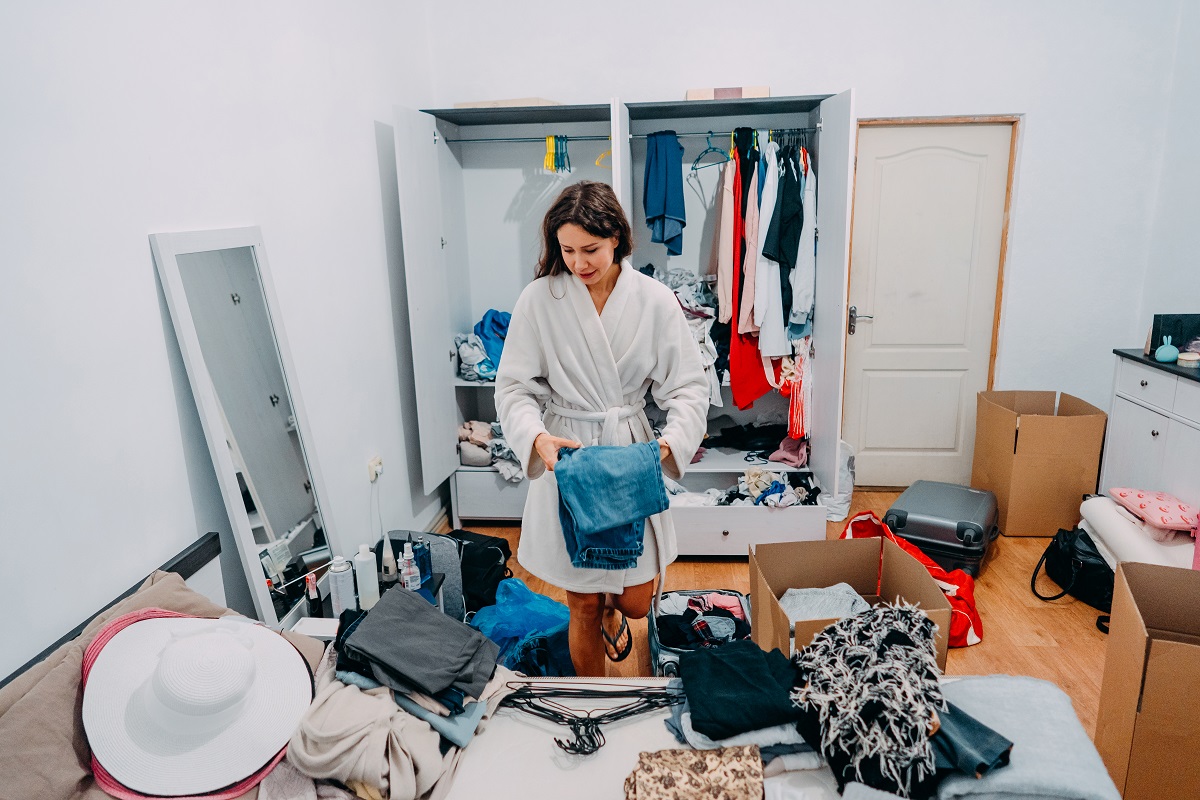

The most useful minimalist habit is not getting rid of things.
It is making fewer unnecessary decisions tomorrow.
That might mean putting the keys in the same place tonight, not buying a fifth water bottle because the four at home already work, keeping the kitchen counter clear enough to prepare breakfast, or deciding that the overflowing towel shelf has reached its limit.
None of those changes would make an impressive before-and-after photograph. That is partly why they matter.
Practical minimalism happens in ordinary moments, long after the donation bags have left the house. It affects how much you have to move, sort, clean, choose, remember, replace, store, and put away.
The goal is not to spend your life practicing minimalism. The goal is to build a few habits that make simplicity easier to maintain without thinking about it all the time.
Table of Contents
ToggleMinimalist Habits Should Reduce Future Decisions
Decluttering can make a home feel better quickly, but the deeper benefit of minimalism comes from what happens afterward.
There are fewer things to manage. Useful possessions become easier to reach. Purchases become more deliberate. Surfaces stay functional longer. Small messes are easier to reset because there is less material competing for the same space.
This leads to a useful principle: a minimalist habit should reduce more decisions than it creates.
Less stuff is useful when it creates less work
Owning less is not automatically easier.
If you reduce your kitchen equipment so aggressively that preparing ordinary meals becomes frustrating, you have removed possessions without removing work.
If you keep so few towels that laundry has to run constantly, the home may look simpler while the routine becomes more demanding.
If a tiny wardrobe means every item requires careful coordination and frequent washing, the number of clothes has fallen but the maintenance may have increased.
The amount you keep should support the way you actually live.
Minimalism works best when fewer possessions lead to fewer things to wash, move, sort, search for, repair, store, or decide between.
Use the fewer-decisions rule
When considering a minimalist habit, ask:
“Will this make an ordinary week easier to operate?”
That question is more useful than asking whether the habit looks minimalist.
Putting all household keys in one place reduces searching.
Keeping ten nearly identical storage categories may increase decisions.
Having a regular place for incoming mail reduces uncertainty.
Creating a complicated rule for every piece of paper may increase it.
Keeping fewer everyday dishes may make cupboards easier to use. Keeping too few can create more washing.
The right habit lowers the amount of thinking required for something that does not deserve much thinking.
Minimalism is about manageable quantity, not minimum quantity
There is no universal minimalist number for shoes, plates, books, toys, kitchen utensils, or shirts.
People have different homes, climates, family sizes, hobbies, work requirements, budgets, and preferences.
A more useful target is manageable quantity.
You probably have a manageable amount when:
- Things fit comfortably in the space available.
- You can find what you normally use.
- Putting things away is straightforward.
- You are not constantly rearranging possessions to make them fit.
- The category does not require frequent major decluttering.
There is no prize for continuing to remove things after the space already works.
Let Repeated Friction Tell You Where to Simplify
A minimalist habit does not have to begin with a whole-house inventory.
Start by noticing where possessions repeatedly interrupt ordinary activities.
Friction is useful information. It shows where the amount, location, or arrangement of things no longer matches the way the space is being used.
Notice what you keep moving out of the way
Some clutter announces itself through movement.
You move appliances before preparing dinner.
You shift a stack of papers before using the dining table.
You remove clothes from a chair before sitting down.
You move six bottles to reach the one product you actually use.
You take several storage tubs out before reaching the seasonal item behind them.
Anything repeatedly moved without being used deserves a second look.
Perhaps it needs another home. Perhaps it is used less frequently and should move out of prime storage. Perhaps it no longer needs to stay at all.
The point is not that every inconvenient object should be discarded. The point is that repeated movement reveals a maintenance cost.
Watch the spaces that become messy immediately
A surface that becomes cluttered a day after being cleared usually has a reason.
The entrance table catches keys, bags, mail, sunglasses, receipts, and whatever people are carrying when they walk through the door.
A chair becomes the place for clothes that are neither clean enough for the wardrobe nor dirty enough for the laundry.
The kitchen counter collects objects that do not have an obvious home nearby.
Instead of repeatedly tidying the same mess, look at what the mess is telling you.
Maybe the keys need a bowl.
Maybe incoming mail needs one tray.
Maybe worn clothes need a hook.
Maybe the counter is holding appliances that are rarely used.
Minimalist habits become sustainable when they solve the cause rather than repeatedly correcting the result.
Pay attention to overfilled containers
A drawer that only closes after you push down on it has already given you useful information.
So has a wardrobe rail packed tightly enough that moving one hanger shifts twenty others.
Storage has a practical capacity that arrives before its absolute physical capacity.
A drawer may technically hold another shirt. That does not mean another shirt improves the drawer.
Leave enough room for the storage to work comfortably.
You should be able to remove something without causing a collapse and put it back without reorganizing the entire category.
Look for categories you repeatedly rebuy because you cannot see what you own
Sometimes clutter creates more consumption.
You buy another roll of tape because you cannot find the three already in the house.
You pick up more shampoo because you do not remember the unopened bottle behind everything else.
You buy another charging cable because nobody knows where the existing ones have gone.
When a category repeatedly produces accidental duplicates, simplifying and giving it one home can reduce both clutter and future purchases.
The habit is not merely “own fewer cables.”
It is “keep the cables where we expect cables to be.”
Notice what takes longer to put away than to leave out
People tend to blame themselves when belongings do not get put away.
Sometimes the storage is the problem.
If returning a frying pan requires removing three others, if putting away shoes means rearranging a crowded shelf, or if hanging a coat requires pushing through an overloaded closet, leaving the object out begins to make practical sense.
The better question is not, “Why can’t I keep this tidy?”
Ask, “Why is putting this away harder than leaving it here?”
Reducing the quantity or simplifying the storage may fix the habit without requiring more discipline.
Build Small Intake Habits So Less Clutter Enters in the First Place
Repeated decluttering can become exhausting when the flow into the home never changes.
You clear a cupboard, donate a bag, and enjoy the extra space. Then new purchases, gifts, packaging, samples, children’s belongings, hobby supplies, and everyday household items slowly fill it again.
You do not need to stop buying things. You need a little more intention at the point where something becomes yours.
Ask where an item will live before buying it
This is a surprisingly practical purchasing question.
Not “Do I like it?”
Not even only “Can I afford it?”
Ask:
“Where will this live?”
A large kitchen appliance needs cupboard or counter space.
A new pair of shoes needs room with the shoes.
A bulk purchase needs somewhere to be stored until it is used.
If there is no obvious place, the purchase is arriving with a storage problem attached.
That does not automatically mean you should not buy it. It means the space requirement deserves to be considered before the item enters the home.
Use a pause for nonessential purchases
A short waiting period is useful because desire changes.
Some items remain appealing after several days. Others become surprisingly forgettable once the immediate excitement passes.
You can keep a simple list of things you are considering rather than purchasing them immediately.
Return to the list later.
If you still want the item and it fits your needs, space, and budget, the waiting period has not prevented the purchase. It has simply made it more deliberate.
This does not need to become an elaborate spending rule. The habit is simply creating a little distance between noticing something and owning it.
Check the category before adding another
Before buying another item in a category that tends to accumulate, look at what you already have.
Another coffee mug?
Open the cupboard.
Another black shirt?
Look at the black shirts you already own.
Another children’s toy?
Notice what is currently available and being used.
The existing quantity becomes more real when you see it before adding to it.
You may still decide that the new item is worthwhile. At least the decision now includes what already needs to be stored.
Be careful with “free” possessions
An object does not stop requiring space because it cost nothing.
Free samples, promotional items, hand-me-downs, giveaways, extra containers, hotel toiletries, event merchandise, and things offered by friends all enter the same physical home as purchased possessions.
You can decline them.
If something has already entered and turns out not to be useful, you can let it go.
The price was zero. The maintenance is not.
Give the Things You Keep Simple Rules and Obvious Homes
Minimalism is not only about what leaves. The possessions that remain need to be easy to use.
A home with fewer things can still feel disorganized if nobody knows where anything belongs.
Simple homes for belongings reduce searching, putting-away decisions, and duplicate purchases.
Give frequently used objects the easiest locations
Storage should reflect frequency.
The frying pan used four nights a week deserves easier access than the appliance used twice a year.
Everyday shoes should not be behind luggage.
The towels used constantly should not require moving spare bedding.
Storage often becomes complicated because the original arrangement survives long after the household’s behavior changes.
Move things according to what happens now.
Give important everyday objects one predictable home
Keys.
Wallets.
Glasses.
Chargers.
Remote controls.
Mail that still needs attention.
The object does not need a sophisticated organizer. It needs a place everyone can predict.
A small tray may be enough. A hook may be enough. One drawer may be enough.
The best home is usually the place where the item naturally gets used or removed.
If everyone takes off their shoes at the entrance, storing everyday shoes on the other side of the house creates unnecessary work.
Let containers become limits, not excuses to keep more
Containers are useful when they define a comfortable boundary.
The toy shelf holds this amount.
The linen cupboard holds this amount.
The kitchen drawer holds the utensils we use.
Problems begin when a full container automatically leads to buying another container.
Before expanding storage, review the category.
If everything still serves a useful purpose and the additional storage genuinely makes the home work better, add it.
If half the container holds forgotten or unwanted things, subtraction may solve the problem more cleanly.
Keep duplicates when the duplicate has a job
Minimalism does not require one of everything.
Two phone chargers can make sense if one stays beside the bed and one stays at work.
Two pairs of scissors can reduce frustration if they belong in different frequently used areas.
Several sets of sheets may suit your laundry habits better than one.
The distinction is intentional duplication.
A duplicate has a reason and a place.
Accidental duplication happens because you forgot what you owned, could not find it, or kept collecting without noticing the total.
Make the easiest action the tidy action
If you want shoes to be put away, the storage should be easier than leaving them in the middle of the floor.
If you want coats hung up, hooks may work better than hangers hidden inside an overfilled closet.
If the family drops mail on the counter, putting the mail tray near the counter may work better than insisting everything immediately reaches an office drawer.
Organization becomes easier when it cooperates with existing behavior.
You can always refine the arrangement later.
Stop organizing when the space works
There is a point where additional organization becomes decorative complexity.
You do not need another label if everyone already knows what is in the drawer.
You do not need separate containers for four items that are easy to find together.
You do not need to reorganize a cupboard because somebody online arranged theirs more beautifully.
A working space is allowed to remain finished.
Minimalism becomes calmer when you stop solving problems that are not causing trouble.
Simplify Everyday Routines by Removing Unnecessary Choice
Minimalism can apply to routines without turning your day into a rigid schedule.
The point is not to optimize every hour. It is to identify repetitive decisions that do not deserve fresh thought each time.
Create defaults for routine household decisions
Defaults reduce the number of small negotiations inside an ordinary week.
You might have a default place for:
- Incoming mail.
- Items waiting to leave the house.
- Donation items.
- Reusable shopping bags.
- Laundry waiting to be folded.
- Household paperwork requiring action.
A default is not a strict rule.
It is simply the answer you use when there is no good reason to invent a different one.
That can remove a surprising amount of low-level household uncertainty.
Reduce the number of steps in recurring chores
A recurring task is worth simplifying if preparation takes almost as long as the task itself.
Cleaning supplies can live near the areas where they are used.
Extra trash bags can stay near the bin.
Laundry products can remain where laundry happens.
Frequently used cooking tools can stay within easy reach.
Every avoided trip across the house is tiny. Repeated hundreds of times, those tiny reductions make the home easier to operate.
Use repeatable choices where variety adds little value
Not every decision needs to remain completely open.
Some people find it easier to repeat a few breakfasts, buy the same household products, keep a small group of reliable outfits, or use the same grocery staples most weeks.
Others enjoy variety and would find that boring.
The useful distinction is whether the choice gives you something you value.
If choosing among twelve nearly identical products every month is irritating, create a default.
If experimenting with food is one of the enjoyable parts of your week, keep the variety.
Simplicity should remove low-value decisions, not enjoyable ones.
Use Short Resets Instead of Waiting for Another Major Declutter
A minimalist home still gets messy.
People live there. Clothes come off. Mail arrives. Groceries enter. Children play. Projects spread across tables. Busy evenings happen.
The goal is not preventing mess. It is making ordinary mess easier to reverse.
Reset the high-friction areas first
You do not need to tidy the entire home each evening.
Choose the areas that have the greatest effect on tomorrow.
For one household, that might be the kitchen counter and dining table.
For another, the entrance and living room.
Return obvious items to their homes.
Clear enough working space for the next use.
Stop when the function is restored.
This is different from cleaning until everything looks perfect.
Keep the reset short enough for a tired day
If your nightly reset requires forty-five minutes, it is unlikely to survive many busy weeks.
Try ten minutes.
Or five.
On an especially difficult day, use the minimum version:
Clear one surface that tomorrow depends on.
Perhaps that is enough to make breakfast easier, give you somewhere to put your bag, or allow you to sit at the table.
The minimum version prevents all-or-nothing thinking from turning one missed reset into five days of accumulating clutter.
Use recurring clutter as information
If the same item is put away every evening and returns to the same wrong place every day, ask why.
Maybe its official home is inconvenient.
If the same cupboard becomes overfilled every month, perhaps too much enters that category.
If one surface repeatedly becomes a holding zone, perhaps the items landing there need nearby homes.
A reset should not become an endless contest with the same design problem.
Change the environment when the evidence keeps pointing in the same direction.
Do a pressure-point review instead of a whole-house review
You do not need a monthly meeting with every possession you own.
Review categories when pressure appears.
The wardrobe becomes difficult to close.
The children’s shelf is overflowing.
The pantry has too many duplicates.
The bathroom drawer has accumulated products nobody uses.
That is the moment for a focused review.
Minimalism becomes far less exhausting when you stop treating the entire home as a permanent project.
Let missed resets stay missed
If you skip the evening reset for three nights, do not create a punishment cleanup.
Return to the normal habit.
Put away what you can in the normal amount of time.
Deal with any larger accumulation separately if necessary.
A maintainable habit allows recovery without drama.
Within Intentional Simplicity, that is the value of a reset: return a space to useful order, then get on with living in it.
Minimalist Habits Need Different Rules in Shared Homes
A person living alone can decide that the household owns four mugs and settle the matter immediately.
A shared home is more complicated because simplicity is partly relational.
Your preferred amount is not automatically everyone else’s preferred amount.
Do not declutter another adult’s belongings
Something that looks useless to you may matter to someone else.
Work on your possessions first.
For shared belongings, discuss the practical issue rather than announcing a minimalist rule.
“This cupboard is so full that we cannot reach the things we use” creates a clearer conversation than “We have too much stuff.”
The first statement describes a problem.
The second can easily sound like a judgment about another person’s habits.
Agree on standards for shared spaces
Private areas can tolerate different preferences.
Shared spaces need enough agreement to remain functional.
You might agree that the dining table stays clear enough for meals, shoes remain within one entrance area, the kitchen counter is reset after dinner, or toys return to a particular zone before bedtime.
The standard does not need to be severe.
It needs to be understandable.
Make children’s systems easy to use
A highly categorized toy organization system may look beautiful after an adult arranges it.
Children may not maintain it.
Broad categories can be easier:
- Blocks.
- Cars.
- Art supplies.
- Dress-up.
- Soft toys.
Open containers may work better than lids and complicated stacking.
The same principle applies as elsewhere: the system should make the desired action easier.
Expect household needs to change
Minimalist habits need revision because life changes.
Children grow. Work arrangements change. Hobbies begin and end. A relative may move in. Someone may start working from home. Seasonal equipment becomes relevant.
A useful arrangement from two years ago may no longer fit.
Changing the arrangement is not evidence that you failed to simplify correctly the first time.
It means the home is supporting a different life now.
Watch for Minimalist Habits That Quietly Make Life More Complicated
Simplicity can become another thing to optimize.
Once that happens, it is possible to spend almost as much time maintaining minimalism as you previously spent managing clutter.
Several warning signs are worth noticing.
You keep removing useful things and buying them again
Repeated replacement suggests the boundary has become too strict.
If you frequently regret removing practical items and have to rebuy them, slow down.
The goal is not to prove that you can live without something.
Keep the items that make recurring activities easier, especially when replacement is expensive or inconvenient.
You create rigid rules for categories that were not causing a problem
One-in, one-out can be helpful for an overflowing shoe collection.
It may be pointless for a category that naturally expands and contracts without creating clutter.
A waiting rule may help with impulse purchases. Applying a mandatory waiting period to toothpaste would be absurd.
Rules deserve a problem.
If there is no recurring friction, you may not need another habit.
You spend more time organizing fewer things
Matching containers, detailed labels, complex storage categories, inventory apps, and elaborate tracking can all be useful in the right situation.
They can also turn a simple home into an administration project.
Ask whether the organization is helping you find, use, or maintain possessions more easily.
If not, simplify the organization too.
You remove enjoyable variety because decisions are supposedly bad
Decision simplicity does not mean avoiding decisions altogether.
Some choices are enjoyable.
Choosing what to cook for friends may be enjoyable.
Choosing a book may be enjoyable.
Choosing an outfit for a special event may be enjoyable.
The target is repetitive, low-value decision load, not every choice that makes life interesting.
You start measuring success by how little you own
A home with fewer possessions can still be inconvenient, uncomfortable, or poorly suited to the people living there.
Count items if a temporary challenge makes the problem clearer, but do not confuse the number with the outcome.
The better measures are ordinary:
Can you find what you need?
Can you put it away easily?
Does the space support the activities that happen there?
Are you spending less time managing things you barely value?
If those answers improve, the minimalist habits are working.
Build Your First Minimalist Habits Around One Annoying Part of the Day
You do not need to turn your home into a minimalism project.
Choose one recurring moment that contains more effort than it should.
Find one decision, one possession problem, and one maintenance problem
Perhaps mornings are frustrating because you cannot find keys.
Give the keys one home.
Perhaps the bathroom cupboard is so full that products fall forward.
Remove the obvious unused items and stop when the cupboard works.
Perhaps the kitchen counter disappears under mail and household objects every evening.
Give those incoming items a simple destination and do a five-minute reset after dinner.
Three small habits can create more practical simplicity than a dramatic weekend purge because they change what happens repeatedly.
Judge the habit by what becomes easier
After a week or two, ignore whether the home looks more minimalist.
Ask what takes less effort.
Are mornings smoother because the keys are where you expect them?
Does the cupboard stay usable longer?
Do you buy fewer duplicates because you can see what you own?
Does the evening reset take five minutes instead of twenty because there is less to put away?
Those changes are small enough to be missed if you are looking only for dramatic transformation.
They are also what sustainable minimalism is supposed to produce.
You do not need to make your life revolve around having less. Build habits that quietly reduce excess, give useful things obvious places, slow unnecessary intake, and make small messes easier to reverse.
When the habit is working, minimalism gradually becomes less noticeable. There are simply fewer unnecessary things asking for your space, money, maintenance, and decisions.